
Start with the role of the food
Complete and complementary describe how a food is intended to be used. They are not a good-versus-bad score.
Complete
Formulated to provide the nutrients needed when fed as directed for the animal and life stage stated.
Complementary
Used alongside other food or as a treat, following its instructions. It should not be the whole diet on its own.
- Neither description alone tells you which product suits your individual cat.
Three places to look on the pack
The front-of-pack ingredient percentage is only one part of the information available.
- Find the description: complete or complementary, the intended species, and the life stage. Keep cat-food decisions separate from dog-food decisions.
- Read the feeding instructions. If you are combining foods and are unsure how they fit together, ask the manufacturer or your veterinary team rather than guessing a ratio.
- Read composition and analytical constituents as different information. One lists ingredients; the other describes aspects such as protein, fat and fibre. Different water content makes wet/dry percentage comparisons difficult.
Try it with two packs
For example, one label might say complete food for adult cats and the other complementary food for adult cats. These are illustrative descriptions, not products we tested.
- Write the exact role, species, life stage and instructions from each pack in the worksheet below.
- Leave unknown information blank and write one question to ask next. There is no winner box.
- You have identified different intended roles, not proved which brand is healthier or whether a particular mixture meets your pet's needs.
What a label cannot settle
An ingredient list alone does not establish overall nutritional quality or suitability. A familiar ingredient name or high meat percentage is not a complete assessment.
- Use the manufacturer's information and your veterinary team for questions about your cat's individual needs.
- This guide explains UK label wording. Other markets use different statements; read local guidance for the pack you are buying.
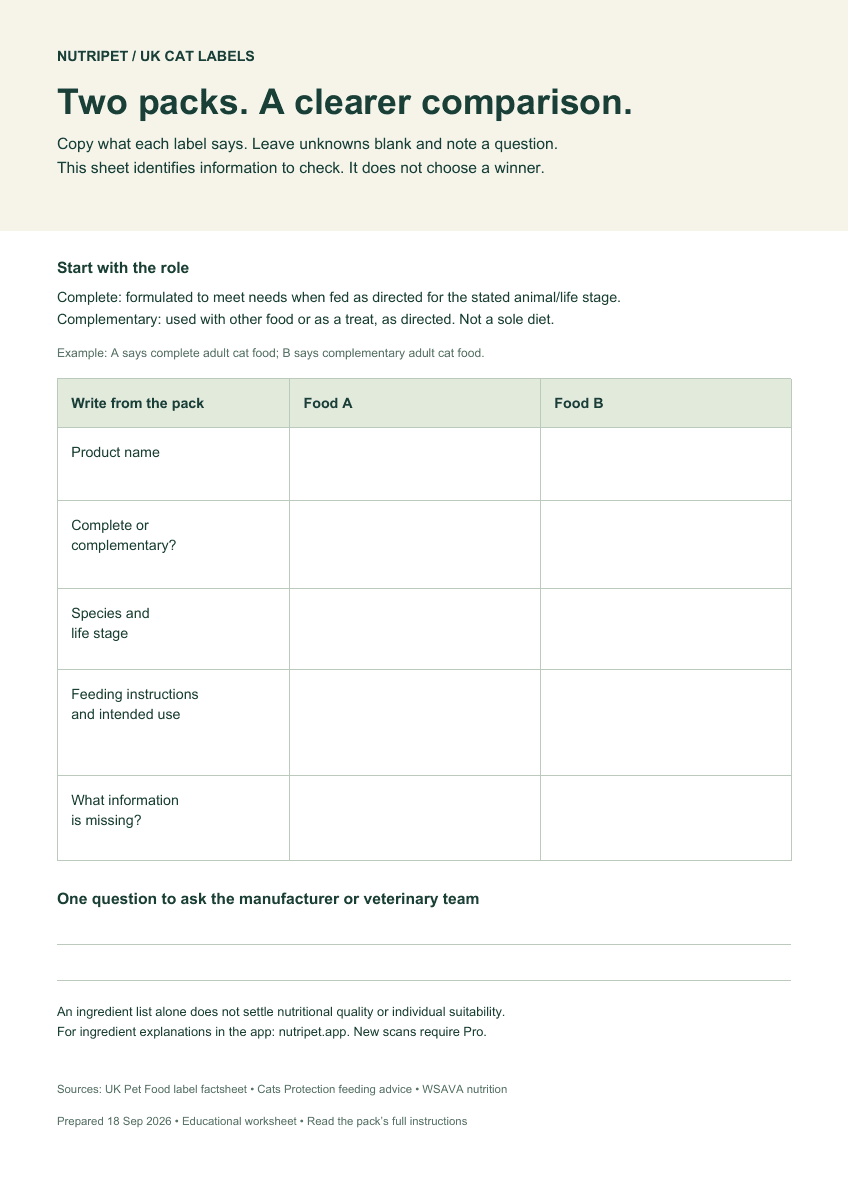
Download the cat-food worksheet (PDF)
One printable A4 page. Record what two packs say and what you still need to ask. No email or account needed.
Download the cat-food worksheet (PDF)FAQ
Does complementary mean poor quality?
No. It describes the intended role. A complementary product is used with other food or as a treat, as directed, rather than as a sole diet.
Can I decide a mixing ratio from these labels?
Not from these descriptions alone. The quantities, feeding instructions and the rest of the diet matter. Ask the manufacturer or your veterinary team if the combination is unclear.
Does a NutriPet grade tell me a food is complete?
No. Find the complete or complementary description on the pack. An app grade is not a determination of nutritional completeness or individual suitability.
Sources
NutriPet editorial reviewEvidence library
- Understanding pet food labelsUK Pet Food
- Global Nutrition GuidelinesWSAVA
- Feeding your catCats Protection
- Cats and human foodsCats Protection
Want to understand an ingredient more clearly?
Take taurine: it is a nutrient cats need in their diet. An unfamiliar word does not automatically mean something bad. NutriPet helps explain dog and cat food ingredients. Return to saved checks and compare up to three saved foods, subject to compatibility limits. New scans require NutriPet Pro.